If you ask anyone in India to name one place in Prayagraj that feels truly special, most people will say the same thing: Triveni Sangam.
It’s not a temple, not a monument, not a fancy tourist location. It’s literally a riverbank. A muddy stretch of water where people sit quietly, pray, laugh, cry, take photos, and sometimes just stare at the flowing rivers like they are watching something bigger than life.
For millions, Triveni Sangam is not just a place. It’s an experience. Many even believe it is the spiritual center of the universe. That may sound dramatic, but once you’re there, you understand why people speak about it with such emotion.
If you are planning a visit, or you simply want to know why this spot is so famous, this guide will explain Triveni Sangam in a way that feels clear and real.
What does “Triveni Sangam” mean?
The name tells you everything.
- Tri means three
- Veni means streams (or braids)
- Sangam means meeting point or union
So Triveni Sangam simply means:
The meeting point of three rivers.
Which three rivers meet at Triveni Sangam?
- Ganga (Ganges)
People recognise the Ganga for its pale, yellowish, silt-filled water. - Yamuna
The Yamuna usually looks deeper and calmer, and often appears greenish or blue. - Saraswati
This is the mysterious one. Saraswati is believed to flow underground and join the other two rivers invisibly.
So yes, you can see two rivers clearly, and the third one is believed by faith to be there.
Can you actually see the rivers mixing?
Yes, you can. And this is one of the coolest parts.
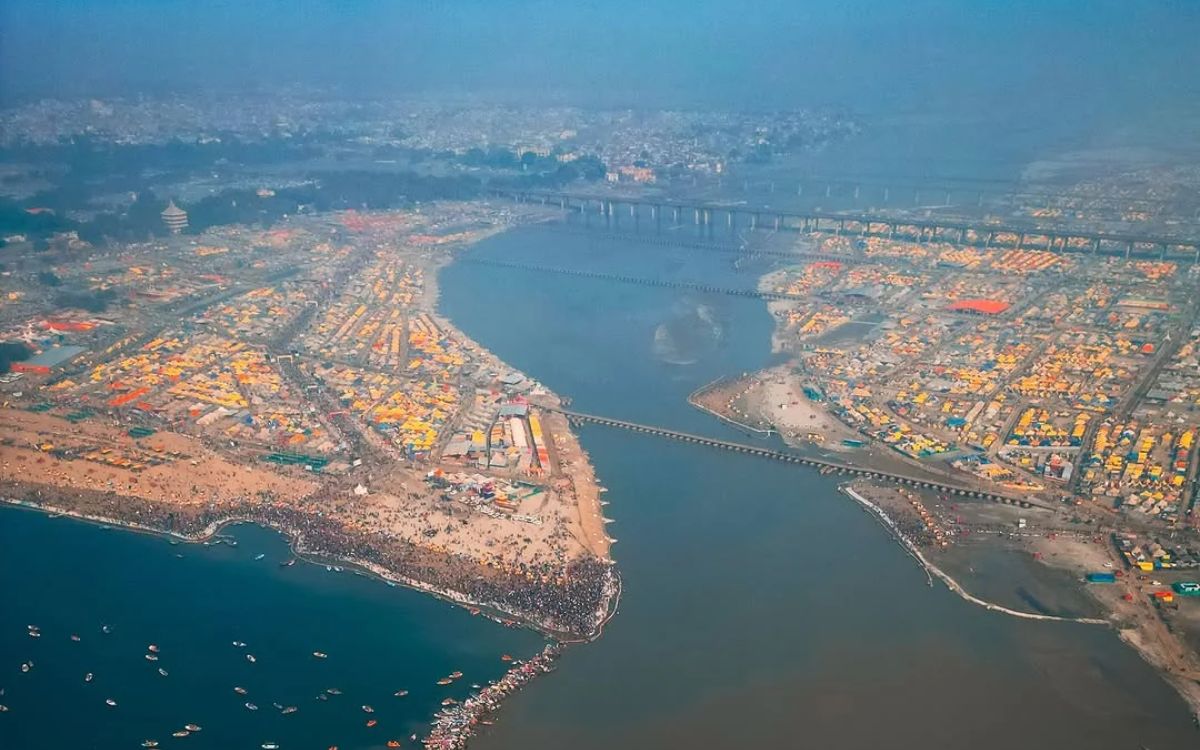
When you reach the confluence point (usually by boat), you can often see a clear difference between the two waters.
- The Yamuna looks darker and calmer
- The Ganga looks lighter and faster
Where they meet, you can see the waters blending slowly. It’s not like a movie effect, but it’s still very noticeable. Many visitors say this is the moment when the Sangam truly feels “real”.
And Saraswati? You won’t see it. But for believers, it is there, joining from below.
Why is Triveni Sangam considered so sacred?
This is where the Sangam becomes more than geography.
In Hindu tradition, Prayagraj is called Prayag Raj, which means the king among pilgrimage places. People believe that bathing here is not just a ritual, it is a spiritual cleansing.
Many devotees believe:
- a dip here washes away sins
- it brings good karma
- it helps the soul move toward Moksha (freedom from rebirth)
That is why you see people taking a holy dip even on cold winter mornings. Some take only a quick dip. Some sit in prayer for an hour. For many, it is a once-in-a-lifetime moment.
The Amrit story: Why Kumbh Mela happens here
One of the biggest reasons Triveni Sangam is world-famous is because of the Kumbh Mela.
The legend goes like this:
During the Samudra Manthan (churning of the ocean), gods and demons fought over a pot of nectar (Amrit). During this struggle, four drops of Amrit fell on Earth.
Those four locations became:
- Prayagraj
- Haridwar
- Ujjain
- Nashik
So people believe the Sangam water holds divine energy, especially during special planetary alignments. That is why Kumbh is not “just a fair”. For devotees, it is the greatest spiritual event.
Kumbh Mela, Ardh Kumbh, and Magh Mela (what’s the difference?)


This confuses many people, so here’s a simple explanation.
Kumbh Mela
Happens every 12 years. Biggest gathering.
Ardh Kumbh
Happens every 6 years. Still very big.
Magh Mela
Happens every year in January-February.
Even when there is no Kumbh, Prayagraj still becomes very spiritual during Magh Mela. Many people, called Kalpavasis, live on the riverbanks for a full month. They eat simply, bathe daily at the Sangam, and spend time in prayers.
It is a rare thing to witness. Very peaceful, very Indian, and very powerful.
The Saraswati mystery (and why people still believe)
Now let’s talk about the Saraswati, because this is the part that makes Sangam feel like a story from another world.
- You can see Ganga.
- You can see Yamuna.
- But Saraswati is believed to be underground.
Scientists have debated whether Saraswati was an ancient river that dried up due to geological changes. But for devotees, the Saraswati is not a debate. It is faith.
Many people also see it symbolically:
- Ganga = purity
- Yamuna = devotion
- Saraswati = knowledge (invisible wisdom)
In a way, Sangam becomes a complete spiritual idea, not just a physical place.
What it feels like to visit Triveni Sangam (real experience)
This is the part that matters most.
Most visitors reach Sangam point by boat. You don’t just walk to the exact confluence in every season. You usually go to a ghat and then take a boat.
The boat ride
Boats are available from ghats like:
- Qila Ghat
- Saraswati Ghat
The boatmen take you toward the spot where the waters meet. Many of them will tell stories, explain where the colours change, and guide you for rituals.
Rituals you will see
At the confluence point, many people perform:
- puja and prayer
- deep daan (floating lamps)
- pinda daan (rituals for ancestors)
Even if you don’t follow these traditions, watching them gives you a strong sense of how deeply people connect with this place.
Siberian birds in winter
If you visit between November and February, you’ll likely see migratory birds, especially seagulls. Feeding them during the boat ride is a common tourist activity.
Akshayavat near Sangam
Near the Sangam area (inside Akbar Fort zone) there is a famous banyan tree called Akshayavat, believed to be immortal. Many pilgrims try to visit it as part of their Sangam trip.
Best time to visit Triveni Sangam
If you want the best experience, do this:
Visit at sunrise.
Early morning Sangam feels completely different:
- cooler air
- softer sunlight
- fewer crowds
- peaceful atmosphere
If you stand there during sunrise, you’ll understand why people call it sacred without even needing an explanation.
Is it safe to bathe at Triveni Sangam?
Yes, generally it is safe, but you must be careful.
A few simple rules:
- bathe only in the marked area
- do not go deep
- avoid jumping or swimming
- keep kids close
- follow local safety instructions (water police are present during mela seasons)
If you are not comfortable, you can still take water in your hand and perform a symbolic ritual.
How to reach Triveni Sangam
Prayagraj is well connected by rail and road. Once you reach the city:
- take auto/e-rickshaw/taxi to Sangam area or Saraswati Ghat
- take a boat ride to the confluence point
If you visit during Kumbh or Magh Mela, routes may be diverted, so plan extra time.
FAQs
Can you see all three rivers meeting at Sangam?
You can clearly see Ganga and Yamuna meeting. Saraswati is believed to be underground and is not visible.
Why is Triveni Sangam so famous?
Because it is a sacred confluence and the main venue for Kumbh Mela. Many people believe a dip here cleanses sins and brings Moksha.
What is Magh Mela?
Magh Mela is an annual spiritual fair in January-February. Many Kalpavasis live simply on the riverbanks and bathe daily at Sangam.
Final thoughts
Triveni Sangam is one of those places you can’t fully explain until you see it. It looks simple, but it feels heavy with meaning. It represents faith, tradition, time, and the idea that different paths can meet at one point and become one.
Whether you visit for spirituality, curiosity, photography, or peace, Sangam stays in your mind long after you leave.

Maharshi Kushwaha is the founder of Prayagraj Portal, a digital platform dedicated to providing accurate news, city updates, culture, education, tourism, jobs, events, and essential services related to Prayagraj (Allahabad). Though he is not originally from Prayagraj, he frequently visits the city and works closely with a strong local team to ensure authentic and responsible reporting. A passionate digital creator and youth entrepreneur, he focuses on building meaningful platforms that promote information access, youth engagement, and community development. His vision is to make Prayagraj Portal one of the most trusted and impactful digital sources for everything related to Prayagraj.