
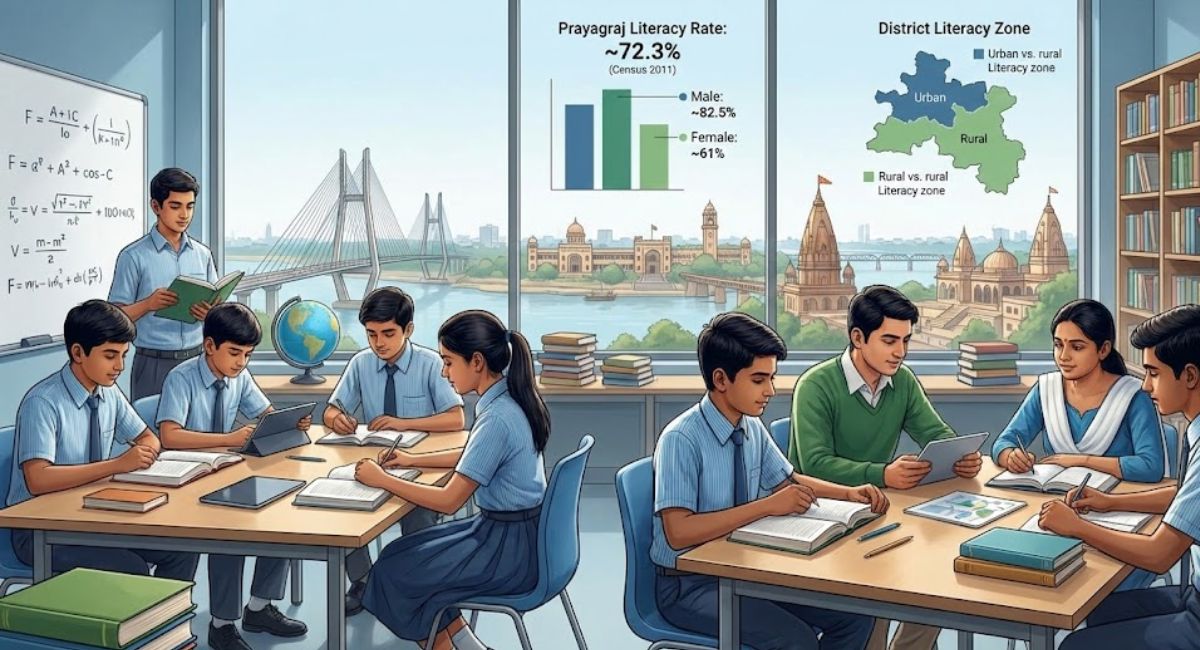
The literacy rate of Prayagraj reflects the educational strength, social progress, and development direction of one of India’s most historic cities. Formerly known as Allahabad, Prayagraj holds a unique place in India’s cultural and academic landscape, with institutions like Allahabad University, government colleges, and traditional learning centers shaping generations of students. Education here is not just about schools and degrees, but about social empowerment, economic growth, and community development.
Understanding the literacy rate of Prayagraj district, including male literacy, female literacy, urban literacy, rural literacy, and tehsil-wise education levels, helps policymakers, educators, NGOs, and citizens identify real gaps and opportunities. Literacy directly impacts employment, health awareness, digital access, and overall quality of life.
This article presents a detailed, area-wise, gender-wise, and tehsil-wise breakdown of Prayagraj’s literacy data based on official Census 2011 figures. You will learn how education levels differ between men and women, how urban and rural regions compare, which tehsils perform best and worst, and what these patterns mean for the city’s future growth and social development.
Overall Literacy Rate of Prayagraj District
The overall literacy rate of Prayagraj district stands at 72.32 percent, which is higher than the Uttar Pradesh state average of approximately 67.7 percent. This shows that Prayagraj performs better than many districts in the state in terms of basic education and reading ability.
Gender-wise Literacy in Prayagraj
- Total Literacy Rate: 72.32%
- Male Literacy Rate: 82.55%
- Female Literacy Rate: 60.97%
Key insight
The gender gap in literacy is clearly visible. Male literacy crosses 82 percent, while female literacy remains below 61 percent. This difference highlights long-standing social, economic, and cultural challenges that affect women’s access to education in many parts of eastern Uttar Pradesh.
Actionable insight:
Community-level awareness programs, girls’ education schemes, and local scholarship initiatives can directly reduce this gap if focused on school retention and higher education access for girls.
Urban vs Rural Literacy Rate in Prayagraj
The urban-rural literacy divide in Prayagraj is one of the most important education patterns in the district. Urban areas benefit from better schools, transport, digital access, libraries, coaching centers, and universities. Rural areas face infrastructure shortages, teacher availability issues, and social barriers.
Urban Literacy Rate in Prayagraj
Urban localities such as Civil Lines, Chowk, Naini, Kareli, George Town, and Allahabad City area show strong literacy performance.
- Urban Average Literacy: 82.51%
- Urban Male Literacy: 86.96%
- Urban Female Literacy: 77.34%
Urban women in Prayagraj have much better access to education compared to rural women, showing the impact of school density, transport access, safety, and family awareness.
Rural Literacy Rate in Prayagraj
Rural blocks and villages show significantly lower literacy, especially among women.
- Rural Average Literacy: 68.76%
- Rural Male Literacy: 80.97%
- Rural Female Literacy: 55.46%
Key observation
The urban female literacy rate is around 77 percent, while the rural female literacy rate drops to nearly 55 percent. This creates a gap of more than 20 percent, making rural women’s education one of the most critical development challenges in the district.
Actionable insight:
Mobile schools, village education centers, digital classrooms, and local female teacher recruitment can directly improve rural female literacy outcomes.
Tehsil-wise Literacy Rate of Prayagraj
The tehsil-wise literacy distribution in Prayagraj shows clear differences between urban-dominated zones and rural belts. Prayagraj has eight major administrative tehsils, each with unique educational conditions.
Allahabad Sadar Tehsil Literacy
- Literacy Rate: 82.08%
This is the highest in the district. It includes major urban areas, universities, coaching hubs, and schools.
Why it performs well:
Presence of Allahabad University, reputed schools, libraries, coaching institutions, digital learning access, and strong student culture.
Soraon Tehsil Literacy
- Literacy Rate: 71.3%
Moderate literacy levels with mixed urban-rural characteristics.
Focus area:
Secondary education access and girls’ school retention.
Phulpur Tehsil Literacy
- Literacy Rate: 70.8%
Primarily semi-rural with growing education infrastructure.
Focus area:
Skill-based education and vocational learning.
Karchhana Tehsil Literacy
- Literacy Rate: 70.9%
Balanced performance but affected by rural schooling challenges.
Focus area:
Teacher availability and transport connectivity.
Handia Tehsil Literacy
- Literacy Rate: 68.3%
Below district average.
Focus area:
Primary education quality and dropout reduction.
Bara Tehsil Literacy
- Literacy Rate: 67.6%
Strong rural influence and limited school infrastructure.
Focus area:
School accessibility and digital learning exposure.
Meja Tehsil Literacy
- Literacy Rate: 67.5%
Part of the Trans-Yamuna rural belt.
Focus area:
Female education programs and community learning centers.
Koraon Tehsil Literacy
- Literacy Rate: 64.7%
Lowest literacy rate in Prayagraj district.
Challenges:
Remote villages, infrastructure gaps, poverty, low school density, social barriers.
Actionable insight:
Targeted government schemes, NGO intervention, and village-level education models are essential for this region.
Education Infrastructure in Prayagraj
Prayagraj’s literacy performance is supported by a strong educational ecosystem:
- Allahabad University – one of India’s oldest universities
- Central Board of Secondary Education schools
- State board schools
- Degree colleges and teacher training institutes
- Coaching hubs for competitive exams
- Madrasa education system
- Digital learning centers
Urban zones benefit the most from this infrastructure, while rural belts still face access gaps.
Social Impact of Literacy in Prayagraj
Higher literacy leads to:
- Better employment opportunities
- Improved health awareness
- Financial inclusion
- Digital participation
- Women empowerment
- Youth skill development
- Civic engagement
- Social mobility
Low literacy, especially among rural women, affects maternal health, child education, and family income stability.
Government Schemes Supporting Literacy in Prayagraj
Several national and state initiatives directly impact education levels:
- Sarva Shiksha Abhiyan
- Beti Bachao Beti Padhao
- Mid-Day Meal Scheme
- Digital India Education Programs
- Samagra Shiksha Abhiyan
- National Literacy Mission
Their impact is visible in rising urban literacy but still needs stronger implementation in rural tehsils.
Why Female Literacy Matters in Prayagraj
Female literacy changes entire family structures. Educated women:
- Ensure better child education
- Improve family health outcomes
- Increase household income stability
- Promote social awareness
- Reduce early marriage rates
- Strengthen community leadership
Improving female literacy in rural Prayagraj is one of the most powerful tools for long-term district development.
Practical Steps for Improving Literacy in Prayagraj
- Community learning centers in villages
- Free digital education access
- Local teacher training programs
- School transport services
- Parent education awareness drives
- Scholarship programs for girls
- Mobile libraries
- Adult literacy programs
These solutions can bring measurable improvements at the grassroots level.
FAQs – Literacy Rate of Prayagraj
What is the literacy rate of Prayagraj district?
The overall literacy rate of Prayagraj district is 72.32 percent according to Census 2011 data.
What is the male literacy rate in Prayagraj?
The male literacy rate in Prayagraj is 82.55 percent.
What is the female literacy rate in Prayagraj?
The female literacy rate in Prayagraj is 60.97 percent.
Which area has the highest literacy in Prayagraj?
Allahabad Sadar tehsil and urban Prayagraj city areas have the highest literacy levels.
Which tehsil has the lowest literacy in Prayagraj?
Koraon tehsil has the lowest literacy rate at approximately 64.7 percent.
What is the rural literacy rate in Prayagraj?
The rural literacy rate is around 68.76 percent, with rural female literacy at approximately 55.46 percent.
Why is there a gender gap in literacy in Prayagraj?
Social norms, early marriage, limited school access, poverty, and safety concerns contribute to lower female literacy.
How can literacy improve development in Prayagraj?
Higher literacy improves employment, health awareness, digital access, women empowerment, and economic stability.
Conclusion
The literacy rate of Prayagraj shows both progress and challenges. With an overall literacy level of 72.32 percent, the district performs better than the state average, reflecting its strong academic heritage and urban education infrastructure. However, deep gaps remain between male and female literacy, and between urban and rural regions.
Urban Prayagraj stands as a strong education center, while rural tehsils like Koraon, Meja, and Bara need focused attention. The future of Prayagraj’s development depends on improving rural education access, strengthening female literacy, and building inclusive learning systems.
By combining community participation, government schemes, student involvement, and digital education models, Prayagraj can move toward a more equal, educated, and empowered society.

Maharshi Kushwaha is the founder of Prayagraj Portal, a digital platform dedicated to providing accurate news, city updates, culture, education, tourism, jobs, events, and essential services related to Prayagraj (Allahabad). Though he is not originally from Prayagraj, he frequently visits the city and works closely with a strong local team to ensure authentic and responsible reporting. A passionate digital creator and youth entrepreneur, he focuses on building meaningful platforms that promote information access, youth engagement, and community development. His vision is to make Prayagraj Portal one of the most trusted and impactful digital sources for everything related to Prayagraj.