
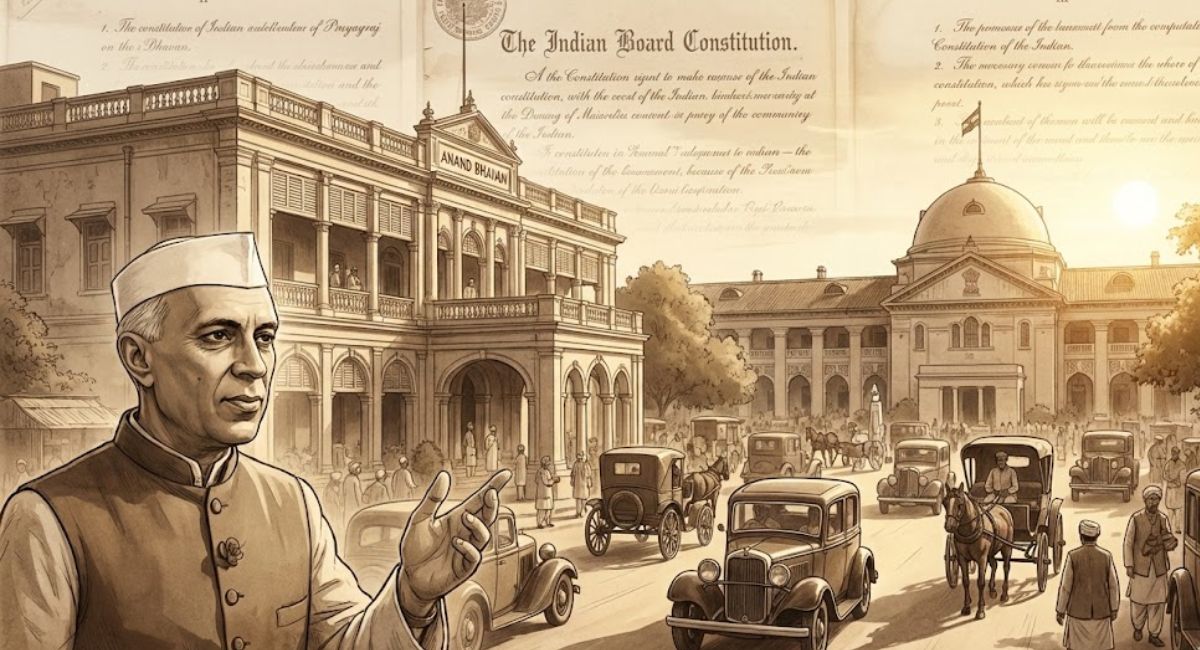
Prayagraj, earlier known as Allahabad, holds a special place in Indian history. Many people know the city for the Kumbh Mela, the holy rivers, and its rich culture. But few realize how deeply Prayagraj influenced the making of the Indian Constitution.
From freedom fighters and political thinkers to legal experts and constitutional leaders, Prayagraj played a major role in shaping India’s democratic framework. The city produced leaders who debated rights, drafted laws, and guided India toward independence and self-governance.
This article explains how Prayagraj contributed to the making of the Indian Constitution. You will learn about key personalities, institutions, events, and ideas that influenced the Constitution. You will also see how Prayagraj became a center of political thought, legal studies, and democratic values in India.
Prayagraj as a Political and Intellectual Center
Prayagraj was one of the most important political cities during the British era. The city hosted major leaders of the Indian National Congress and became a hub of freedom movement activities.
The Allahabad High Court, established in 1866, was one of the most influential courts in British India. Many future constitutional experts studied and practiced law here.
Allahabad University, founded in 1887, became a leading center for political science, law, and public administration. Students and teachers discussed democracy, rights, and governance long before India became independent.
Key Leaders from Prayagraj Who Shaped the Constitution
Jawaharlal Nehru and Democratic Vision
Jawaharlal Nehru was born in Allahabad in the Anand Bhavan family. He became the first Prime Minister of India and a major leader in the Constituent Assembly.
Nehru presented the Objectives Resolution in 1946, which later became the Preamble of the Indian Constitution. He believed in democracy, secularism, equality, and social justice.
His ideas influenced fundamental rights, parliamentary democracy, and India’s federal structure.
Motilal Nehru and Constitutional Planning
Motilal Nehru, father of Jawaharlal Nehru, was a prominent lawyer and leader of the Indian National Congress.
In 1928, he chaired the Nehru Committee, which drafted the Nehru Report. This report proposed a written constitution for India with fundamental rights and responsible government.
Many ideas from the Nehru Report later appeared in the Indian Constitution, such as civil liberties and democratic governance.
Indira Gandhi and Constitutional Amendments
Indira Gandhi also belonged to Allahabad and later served as Prime Minister of India.
Although she was not part of the original Constituent Assembly, she shaped the Constitution through major amendments. These included changes related to property rights, emergency powers, and social justice policies.
Other Influential Figures Linked to Prayagraj
Many constitutional thinkers, lawyers, and politicians studied or worked in Prayagraj, including:
- Rajendra Prasad, first President of India, who studied law and practiced in Allahabad High Court
- Shyamaprasad Mukherjee, educationist and political leader associated with Allahabad University
- Tej Bahadur Sapru, constitutional reform advocate and Allahabad lawyer
Their debates and writings influenced constitutional discussions.
Allahabad High Court and Legal Thought
The Allahabad High Court played a major role in shaping Indian legal thinking.
Judges and lawyers from this court contributed to constitutional debates, legal reforms, and civil rights discussions. Many High Court advocates later became judges in the Supreme Court of India.
The court also promoted rule of law, judicial independence, and constitutionalism, which became core principles in the Indian Constitution.
Allahabad University and Constitutional Education
Allahabad University was called the Oxford of the East.
The university taught political science, law, philosophy, and history. Professors and students discussed ideas like democracy, federalism, socialism, and human rights.
Many members of the Constituent Assembly had academic connections with Allahabad University. This made Prayagraj an intellectual foundation for constitutional ideas.
Prayagraj and the Indian National Congress
Prayagraj hosted several sessions of the Indian National Congress. Anand Bhavan served as the headquarters of Congress activities for many years.
Leaders planned protests, drafted policies, and discussed future governance models here. These discussions influenced how India would be governed after independence.
Contribution to Fundamental Rights
Leaders from Prayagraj strongly supported civil liberties and social equality.
The Nehru Report proposed rights such as:
- Freedom of speech
- Freedom of religion
- Equality before law
- Protection against discrimination
These ideas later formed the Fundamental Rights in Part III of the Indian Constitution.
Role in Parliamentary Democracy
Prayagraj leaders supported parliamentary democracy based on the British model.
Jawaharlal Nehru promoted a system where the Prime Minister and Council of Ministers are responsible to Parliament. This system was adopted in the Indian Constitution.
The city’s political thinkers believed in elections, political parties, and representative government.
Federal Structure and Center State Relations
Prayagraj thinkers debated how power should be divided between the central government and states.
The Nehru Report proposed a federal system with a strong center. This idea influenced India’s federal structure, where the Union government has more powers than states in certain areas.
Secularism and Social Justice Ideas
Prayagraj leaders strongly supported secularism and social reform.
Jawaharlal Nehru promoted equal rights for all religions and castes. Indira Gandhi supported policies for poverty reduction and social welfare.
These ideas shaped Directive Principles of State Policy, which guide the government in building a welfare state.
Women and Youth Voices from Prayagraj
Prayagraj also contributed to women and youth participation in politics.
Leaders from the Nehru family encouraged women’s education and political involvement. Students from Allahabad University participated in freedom movements and political debates.
Their voices influenced democratic values and inclusive governance.
Prayagraj in the Constituent Assembly Era
During 1946 to 1950, many Constituent Assembly members visited Prayagraj, discussed drafts, and consulted legal experts.
Anand Bhavan and Swaraj Bhavan served as informal centers of political planning. The city provided intellectual and political support during constitution drafting.
Cultural and Philosophical Influence
Prayagraj’s culture influenced constitutional values. The city represents unity of rivers, religions, and communities.
This cultural diversity inspired ideas of unity in diversity, tolerance, and pluralism, which became core constitutional principles.
Legacy of Prayagraj in Modern India
Today, Prayagraj continues to inspire democratic values.
Educational institutions, courts, and cultural centers still promote constitutional awareness. The city remains a symbol of India’s political and intellectual heritage.
Conclusion
Prayagraj played a deep and lasting role in the making of the Indian Constitution. The city produced visionary leaders, legal experts, and thinkers who shaped democracy, rights, and governance in India. From the Nehru family to Allahabad High Court and Allahabad University, Prayagraj contributed ideas that built the foundation of the world’s largest democracy.
Understanding Prayagraj’s role helps us appreciate how India’s Constitution emerged not only from Delhi but also from historic cities where ideas, debates, and dreams of freedom were born.
FAQs Section
Q1. Why is Prayagraj important in the making of Indian Constitution?
Prayagraj produced key leaders like Jawaharlal Nehru and Motilal Nehru and hosted major political discussions that influenced constitutional ideas.
Q2. What was the Nehru Report?
The Nehru Report was a 1928 document that proposed a constitution for India with fundamental rights and democratic governance.
Q3. How did Allahabad High Court influence the Constitution?
The court shaped legal thinking, rule of law, and judicial independence, which became key constitutional principles.
Q4. Did Allahabad University contribute to constitutional ideas?
Yes, the university educated many political thinkers and lawyers who discussed democracy, federalism, and rights.
Q5. How did Jawaharlal Nehru shape the Constitution?
He introduced the Objectives Resolution, which became the Preamble, and promoted democracy, secularism, and equality.
Q6. What role did Indira Gandhi play in constitutional development?
She introduced major constitutional amendments related to social justice and governance.

Maharshi Kushwaha is the founder of Prayagraj Portal, a digital platform dedicated to providing accurate news, city updates, culture, education, tourism, jobs, events, and essential services related to Prayagraj (Allahabad). Though he is not originally from Prayagraj, he frequently visits the city and works closely with a strong local team to ensure authentic and responsible reporting. A passionate digital creator and youth entrepreneur, he focuses on building meaningful platforms that promote information access, youth engagement, and community development. His vision is to make Prayagraj Portal one of the most trusted and impactful digital sources for everything related to Prayagraj.