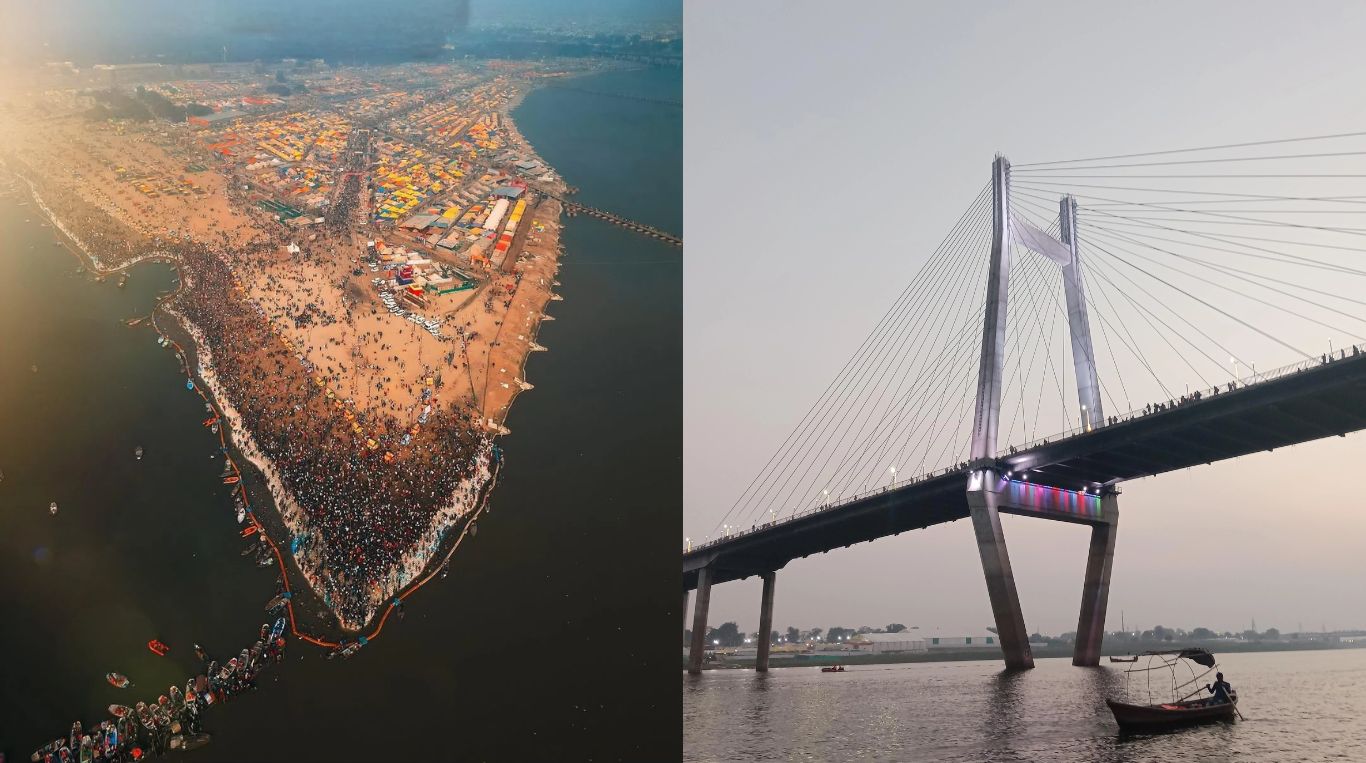
Many people ask a simple but powerful question – which king started Kumbh Mela at Allahabad (now Prayagraj)? The Kumbh Mela is the largest religious gathering in the world, deeply rooted in Hindu faith, mythology, and tradition. While its spiritual origins come from ancient legends, history gives us a clear answer about who first organized the grand human gathering at Prayagraj in a structured and recorded form.
The historical credit goes to King Harshavardhana, a महान भारतीय राजा (great Indian king) of the 7th century. He did not invent the spiritual belief of Kumbh, but he became the first ruler to organize a massive religious assembly at the Triveni Sangam. His actions laid the foundation for what later evolved into today’s world-famous Prayagraj Kumbh Mela.
This article explains the real historical truth, ancient roots, records by foreign travelers, and how Kumbh Mela developed into a global spiritual event.
King Harshavardhana and the Beginning of the Kumbh Gathering
Who was King Harshavardhana
King Harshavardhana ruled India from around 606 CE to 647 CE. He belonged to the Pushyabhuti dynasty and ruled a large part of North India. He was known not only for his political power but also for his धार्मिकता (spiritual nature), charity, and support for education and religion.
Although he followed Buddhism, he respected all religions and promoted धार्मिक एकता (religious harmony). His rule is remembered for peace, learning, and large public welfare activities.
The first organized religious assembly at Prayagraj
King Harshavardhana is the first recorded historical figure who organized a massive religious gathering at Prayag, which is today called Prayagraj. This took place at the Triveni Sangam, the sacred confluence of:
- River Ganga
- River Yamuna
- Mythical River Sarasvati
This event was not called Kumbh Mela at that time. It was known as Moksha Parishad.
Xuanzang’s record – the first written evidence
Who was Xuanzang (Hiuen Tsang)
Xuanzang was a Chinese Buddhist monk and traveler who visited India in the 7th century. He traveled across the country to study Buddhism, Indian culture, and philosophy. His travel records are one of the most trusted historical sources for ancient Indian history.
The Moksha Parishad of 644 CE
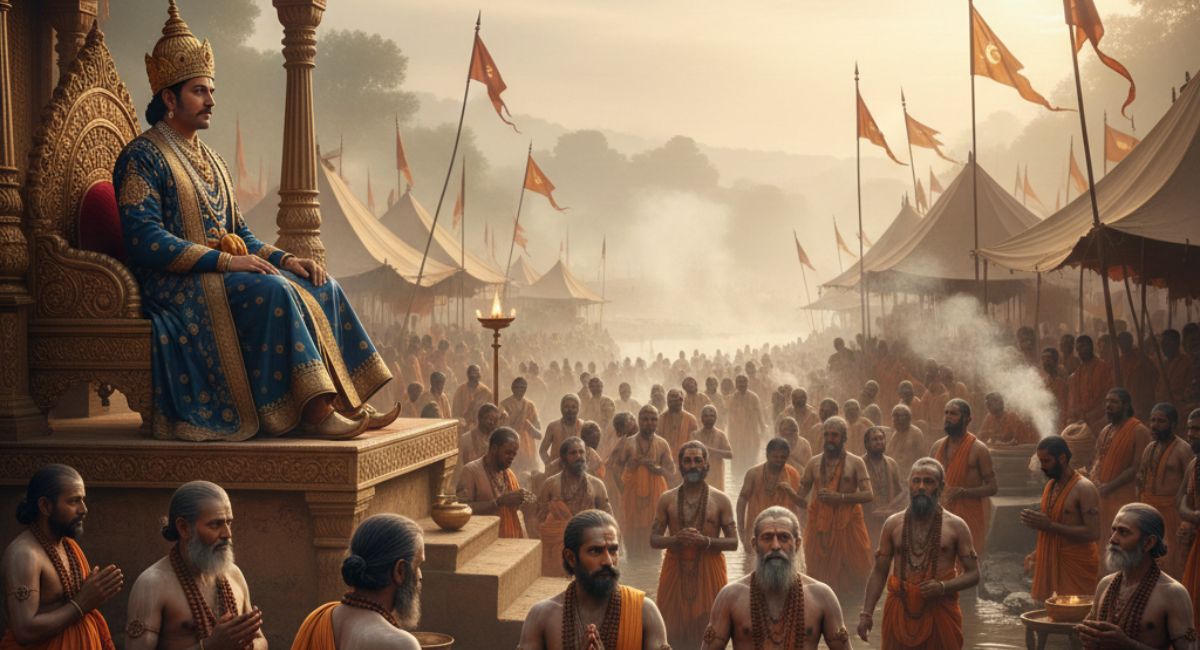
Xuanzang documented a massive religious gathering held in 644 CE at Prayag. He described how King Harshavardhana invited:
- Monks
- Scholars
- Saints
- Brahmanas
- Poor people
- Followers of different religions
This gathering happened every five years and focused on charity, spiritual discussion, and religious unity.
This is the earliest historical record of a grand religious assembly at Prayagraj, making King Harshavardhana the first known king to start such an organized tradition.
The legendary charity of King Harsha
Daan tradition and spiritual leadership
One of the most powerful parts of this history is King Harsha’s act of charity. According to Xuanzang:
- King Harsha gave away his entire treasury
- He donated gold, silver, jewels, clothes, and wealth
- He even gave away his personal garments
- In the end, he had to borrow a simple secondhand robe to wear
This act of Daan (दान) made him a symbol of sacrifice and service. This spirit of charity is still part of Kumbh Mela today, where people donate food, clothes, and services freely.
Interfaith nature of the early gatherings
Although King Harshavardhana followed Buddhism, his gatherings were not limited to one religion. They included:
- Hindu Brahmanas
- Buddhist monks
- Scholars of different traditions
- Spiritual teachers from multiple sects
This interfaith participation shaped the inclusive nature of modern Kumbh Mela, where different धार्मिक संप्रदाय (religious sects) gather peacefully.
How Kumbh Mela evolved over centuries
Puranic origins of Kumbh
The word “Kumbh” comes from the ancient myth of Samudra Manthan (Churning of the Ocean). According to Hindu belief:
- Gods and demons churned the ocean for Amrit (nectar of immortality)
- A divine pot (Kumbh) carried the nectar
- Drops fell at four places
- Prayagraj
- Haridwar
- Ujjain
- Nashik
These places later became the four sacred Kumbh locations.
This gives the spiritual origin, but not the historical organization.
Role of Adi Shankaracharya
Organizing spiritual orders
In the 8th century, Adi Shankaracharya played a major role in shaping Hindu religious institutions. He:
- Organized Akharas (monastic orders of sadhus)
- Created structured religious systems
- Promoted spiritual debates and philosophy
These Akharas later became central to the Kumbh Mela structure, especially in rituals like Shahi Snan.
Mughal and British period influence
Formalization of the event
During the Mughal and British periods:
- The term Kumbh Mela became commonly used
- British administration documented the event
- Crowd management, security, and logistics improved
- Administrative systems were introduced
By the 18th and 19th centuries, Kumbh Mela became a formally recognized mega religious fair.
Why King Harshavardhana is called the founder
King Harshavardhana is not the creator of the spiritual belief of Kumbh, but he is the historical founder of the organized Kumbh tradition at Prayagraj because:
- He organized the first large documented religious gathering
- He institutionalized public spiritual assemblies
- He created a tradition of mass participation
- He linked charity with spirituality
- His event took place at the Triveni Sangam
- His gathering became the foundation of later Kumbh structures
This makes him the true historical answer to the question.
Key rituals that connect to history
Shahi Snan
The royal bath is led by Akharas in a sacred procession. It reflects the structured spiritual leadership that developed over centuries.
Sangam Snan
The holy dip at Triveni Sangam continues the ancient belief of spiritual purification.
Akhara processions
These show the institutional religious structure started after Adi Shankaracharya’s reforms.
Frequency of Kumbh Mela at Prayagraj
- Ardh Kumbh – every 6 years
- Maha Kumbh – every 12 years
Prayagraj holds special importance because it is the only place where Maha Kumbh is celebrated.
Global recognition of Kumbh Mela
Kumbh Mela is recognized by UNESCO as Intangible Cultural Heritage of Humanity. It is considered the largest peaceful human gathering in the world.
This global recognition connects ancient Indian spirituality with modern global respect.
Clear answer to the main question
Which king started Kumbh Mela at Allahabad
King Harshavardhana is the historical king who started the organized religious assembly tradition at Allahabad (Prayagraj).
He organized the first recorded grand gathering in 644 CE at Triveni Sangam, known as Moksha Parishad.
This event later evolved into what we now call the Kumbh Mela.
Conclusion
The Kumbh Mela is not the creation of one moment or one ruler. Its spiritual roots come from ancient Hindu mythology, but its historical foundation at Prayagraj begins with King Harshavardhana. His Moksha Parishad in 644 CE marks the first recorded grand religious gathering at the Triveni Sangam. Through charity, inclusion, and spiritual leadership, he shaped a tradition that grew across centuries into the world’s largest spiritual congregation. Today’s Prayagraj Kumbh Mela stands as a living symbol of India’s faith, unity, and cultural continuity.
FAQs
Who started Kumbh Mela at Prayagraj
King Harshavardhana started the first organized religious gathering at Prayagraj in 644 CE.
Was Kumbh Mela started in Vedic times
The belief comes from ancient mythology, but the organized event began in the 7th century.
What was the first Kumbh called
It was called Moksha Parishad during King Harsha’s time.
Who recorded the first Kumbh gathering
Chinese traveler Xuanzang recorded it in his travel accounts.
Why is Prayagraj important for Kumbh Mela
Because it is the Triveni Sangam, the confluence of three sacred rivers.

Maharshi Kushwaha is the founder of Prayagraj Portal, a digital platform dedicated to providing accurate news, city updates, culture, education, tourism, jobs, events, and essential services related to Prayagraj (Allahabad). Though he is not originally from Prayagraj, he frequently visits the city and works closely with a strong local team to ensure authentic and responsible reporting. A passionate digital creator and youth entrepreneur, he focuses on building meaningful platforms that promote information access, youth engagement, and community development. His vision is to make Prayagraj Portal one of the most trusted and impactful digital sources for everything related to Prayagraj.